Cross-cultural connection
Meet people from different countries, one real voice at a time.
To meet people from different countries without traveling, start a live voice conversation. Mindfuse connects you with a stranger from another country by anonymous voice: no profile, no video, no algorithm steering who you meet. Just two people talking. Two weeks free, then 3 free conversations every week, or upgrade in the app for unlimited.
- Random global matching: the person you meet may be on the other side of the world.
- When it is night where you are, it is day somewhere else, so someone is usually awake.


Someone, somewhere, is awake.
- Mexico City
- New York
- São Paulo
- London
- Lagos
- Cairo
- Mumbai
- Jakarta
- Seoul
- Sydney
- Meeting someone from another country shows you that your own defaults are one option among many.
- Underneath the differences, you reach what is shared surprisingly fast, and you only really believe that in a live conversation.
- Voice helps you understand people; social media mostly helps you discover them.
- On Mindfuse you are matched at random with a stranger anywhere in the world, by anonymous voice. Two weeks free, then 3 free conversations every week.
Most of the people you will ever speak to share your basic operating assumptions: roughly your sense of how families work, what success looks like, what is rude and what is normal. It is comfortable, and it is also a kind of confinement. The specific value of meeting someone from a different country is that you encounter a person whose defaults are simply not your defaults, and that is far more interesting than it sounds.
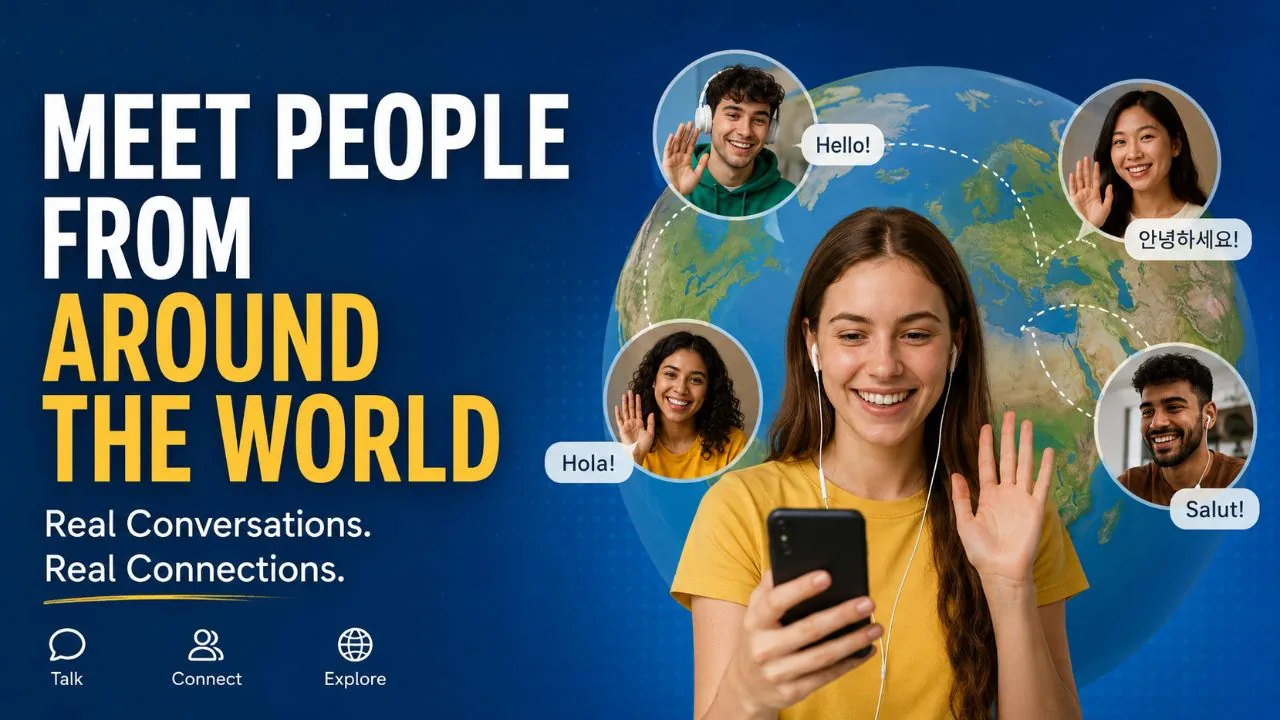
The value is in the friction of assumptions
Talk to someone who grew up where it is normal for three generations to share a home, or where leaving the city you were born in is unusual, or where the question of what you do for a living is considered slightly invasive. Suddenly your own arrangements stop feeling like the way things are and start feeling like one option among many. This is not a small thing. It is the difference between inheriting a worldview and choosing one, and you cannot do the second without first seeing that alternatives exist.
The friction is the point. It is the moment another person's casual answer makes you notice an assumption you did not know you were carrying.
And then the part that surprises everyone
People expect the differences. What they do not expect is how quickly, underneath them, you reach something held entirely in common, a worry about a parent getting older, an old ambition quietly abandoned, the same joke landing across a language barrier. Meeting people from different countries is the most efficient way to learn both halves of a single fact: that human experience is astonishingly varied on the surface, and astonishingly shared underneath. You cannot fully believe that until you have felt it in a live conversation.
Talking across cultures: why a stranger gets the honest version
People imagine a conversation between strangers from opposite ends of the world would be all friction. Sometimes it starts that way: a few minutes of careful circling. Then, surprisingly often, it reaches a kind of openness that conversations between people who know each other rarely do.
There is a paradox here. The distance that should make honesty harder is what makes it possible. A stranger from another country has no stake in your reputation, will never meet your friends, and has no fixed idea of who you are meant to be. So people say the true thing: the doubt they would not voice at home, the question they would be embarrassed to ask a neighbor. Anonymity does not cheapen the exchange. It is what lets it become real.
Conversations do what stereotypes cannot
Most opinions about other countries are formed without ever speaking to someone who lives there. A single real conversation tends to replace those assumptions with a person, and people turn out to be far more complex than the labels attached to their country or culture. Research consistently finds that meaningful conversations between people of different backgrounds reduce prejudice and build empathy, which is one of the most quietly valuable things about talking across borders. If the evidence interests you, we collected it in our polarization statistics.
Why voice feels more personal than social media
Social media helps you discover people. Voice helps you understand them. Most platforms are built around photos and carefully chosen moments, so you see what people choose to share but rarely have a genuine conversation. Voice changes that completely: you hear laughter, hesitation, and emotion as they happen, and small details like tone and pauses make someone feel real instead of just another profile. Many people find it easier to build trust in one voice conversation than in weeks of messaging.
How a global conversation app works
Many platforms call themselves global but mostly match you with people nearby or people the algorithm thinks are similar to you. A genuinely global conversation app has no geographic filter: you tap to start, you are matched with whoever is available, and that person may be on the other side of the world. You cannot pick who you get, and that is the point. When you cannot predict who you will speak with next, every call is new. You might talk to someone in South Korea about work culture, someone in Brazil about their neighborhood, or someone who moved from Nigeria to Europe about what surprised them most.
A global pool also solves the time zone problem. When it is the middle of the night for you, it is the middle of the day somewhere else, so there is usually someone awake to talk to.
What to look for in a global conversation app
- Real global reachA “global” label means little if most people you meet are from one region.
- Voice at the centerIf you want to talk, choose a service where speaking is the main thing, not an extra beside a text feed.
- Random matchingYou should be able to start talking without searching profiles first.
- PrivacyKnow what the other person can see about you. On Mindfuse they see no profile, username, or photo, and your phone number (used for verification) is never shown to them.
- Few steps to a conversationThe more setup there is, the more it starts to feel like a traditional social network.
If your main goal is structured practice in one language, a dedicated language exchange app or a way to talk to native speakers online may suit you better. If you want the conversation itself to be the point, random global voice is the simplest route.
Best ways to meet people from different countries
There is no single best way. The right choice depends on the kind of connection you want: some people want to practice a language, others want a real friendship, others just enjoy learning about a place through the person who lives there. The platforms worth your time are the ones that encourage genuine interaction instead of endless scrolling.
| Method | Best for | Main advantage | Main limitation |
|---|---|---|---|
| Voice conversations | Real conversations | Personal and spontaneous | Can feel awkward at first |
| Language exchange | Language practice | Learn naturally with speakers | Language ability can vary |
| Online communities | Shared interests | Easy conversation starters | May stay community-based |
| Gaming communities | Casual interaction | Shared activity removes pressure | Often focused on gaming |
| Travel communities | Travel and culture | Learn from local experiences | Less spontaneous |
| Pen pals | Slow friendships | More thoughtful conversations | Takes longer to build |
Voice conversations
Voice is one of the fastest ways to build a real connection with someone from another country. You hear their tone, humor, and hesitation in a way text cannot capture. There is no need to prepare a perfect introduction, just start with where you live, what you do, or what life is like where you are, and let it go wherever both people want.
Language exchange
Two people help each other practice languages while sharing stories about their cultures and daily lives. You pick up slang, humor, and expressions that never appear in textbooks. If speaking is your goal, our guide to the best language exchange apps explains how to choose one.
Online and travel communities
Communities built around a shared interest, photography, books, fitness, travel, give you something to talk about from the start, so you are not introducing yourself from scratch. Travelers in particular tend to share recommendations and local stories you would never find in a guidebook.
How to join a global community online
Most of us socialize within a small geographic and cultural radius, and the perspectives around us are a tiny sample of human experience. The technology to be part of a genuinely global community already exists. Most people just use it to talk to people who are already like them. Beyond the methods above, two more approaches help:
Join global online events
Many conferences, workshops, and community events now run online and attract international audiences. Showing up and taking part gives you natural reasons to start talking to people from other countries.
Engage with international creators
Following creators from different countries, and actually joining the discussion around their work rather than just scrolling past, gives you steady exposure to other perspectives and the occasional real connection.
Connect with people worldwide, not just follow them
The internet gives everyone global access: you can follow people from every country and see content from anywhere. But access is not connection. Watching content from another country stands in for knowing someone there, and the content is not the person. Connection needs something from both sides, attention, honesty, and real exchange, and that only happens when two people actually talk and listen.
How Mindfuse works
Mindfuse connects you with a stranger from another country by anonymous voice, no profile, no video, no algorithm steering who you meet. Just two people talking. Two weeks free, then 3 free conversations every week. Every match is a random voice chat, which is exactly what makes the encounter feel real rather than curated.
- Download and verify onceGet Mindfuse on iOS or Android and verify your phone number. The person you talk to never sees it, and sees no profile, username, or photo either.
- Tap to be matchedThere is no geographic filter. You are matched with whoever is available, and that person may be on the other side of the world.
- Talk, and let it go where it goesStart with where you live, what you do, or what life is like where you are. When the conversation has run its course, a simple goodbye is enough.
How to start a conversation with someone from another country
Start with simple questions about where they live and their everyday life. You do not need a perfect opening, a genuine question is enough. A few that work well:
- “What is your everyday life like where you live?”
- “What do you usually do on weekends?”
- “What food is popular in your area?”
- “What is something foreigners often misunderstand about your country?”
- “What is one thing you really like about where you live?”
Let it develop naturally rather than firing off questions one after another, and share something about yourself too, so it feels like a conversation and not an interview. If the idea makes you nervous, that is completely normal, most people find talking to someone new gets comfortable within the first few minutes.
Which country should you talk to first?
A useful way to choose is to start from what you want out of the conversation, not from a map. Ask yourself which difference interests you most: how people think about work and rest, about family and obligation, about politics and power, or about how to treat strangers. Then notice what feels most foreign to your own culture, whether that is indirect communication, putting the community before the individual, or very blunt directness.
If you want the conversation that challenges something you think you know, look for a culture whose defaults differ most from yours on the question you care about. If you want warmth first, or big philosophical questions, or plain practical honesty, follow that instead. Just remember that a country is not a personality: the person you actually meet will always be more specific, and more surprising, than any national generalization. Our guides to talking with people in Europe, in America, or from the Philippines are good places to start if you already have a country in mind.
A 30-day plan for talking with people around the world
Regular conversations with people from other countries are also one of the best ways to get better at conversation itself. A simple four-week focus keeps that practice useful.
Days 1 to 7: get comfortable starting
Open each call with a simple introduction or question instead of hunting for the perfect first line. Get used to unfamiliar accents, and stay in the conversation through the first few awkward seconds. The goal is comfort, not complexity.
Days 8 to 14: practice listening
Let the other person finish, ask a follow-up based on what they actually said, and ask for clarification when you miss something. After each call, ask yourself: did I respond to what they said, or to what I planned to say?
Days 15 to 21: speak more clearly
Use familiar words and shorter sentences, slow down a little when needed, and rephrase an idea rather than repeating the same sentence louder. The goal is not to sound perfect. It is to be easy to follow.
Days 22 to 30: go deeper
Give fuller answers, connect each question to the last answer, share your own view, and let the conversation end naturally when it is done. By the end, the useful measure is not how many calls you made, but whether starting, listening, and explaining feel more natural than they did on day one.
Staying safe when you meet people online
Most conversations are friendly and respectful, but a few simple habits let you enjoy the experience with confidence.
What to share
Start with everyday topics like hobbies, travel, food, and music. There is no need to share personal details in a first conversation, and never give out your home address, financial information, passwords, or anything that identifies you off the platform.
Stay anonymous
Platforms that allow anonymous conversations let you focus on the discussion instead of your identity. You can meet someone new without handing over your phone number or social profiles, which makes the whole thing more comfortable, especially the first time.
Recognize red flags
Trust your instincts and leave any conversation that feels off. Be cautious if someone quickly asks for money, personal information, or private photos, or pushes to move to another platform straight away.
Meet people from different parts of the world
You do not need to travel to have these conversations, and you do not need to decide where someone should be from before you start, sometimes not knowing who you will meet is the best part. But if you are curious about a particular country or region, these guides are a good starting point.
North America
Europe
Australia and Oceania
Frequently asked questions
What is the best way to meet people from other countries?
It depends on what you want from the connection. Voice conversations, language exchange, online communities, and travel groups are all good ways to meet people from different countries. Voice is the fastest way to feel like you are actually talking to someone rather than reading their posts.
How can I make international friends online?
Start on a platform where people from different countries talk and interact naturally, then focus on genuine conversations around shared interests, culture, hobbies, or everyday life. Friendships grow from conversations both people choose to continue.
Can I meet people from other countries without traveling?
Yes. You can meet people from around the world through voice calls, language exchange platforms, online communities, and gaming groups. You can learn about another country without leaving home.
Is it safe to talk to people from other countries online?
It can be, when you use a platform with good privacy and safety features. Avoid sharing your address, financial details, or passwords, and leave any conversation that makes you uncomfortable.
Do I need to speak another language to make international friends?
No. Simple language, patience, and a willingness to learn are usually enough to start a meaningful conversation. Most people appreciate the effort far more than perfect grammar.
How do I start a conversation with someone from another country?
Start with an easy question about their everyday life: where they live, what they do on weekends, what food is popular there, or what a normal day looks like. A genuine question is usually enough to get things moving.
Can talking to people from other countries improve my language skills?
Yes. Real conversations help you pick up natural pronunciation, common phrases, slang, and everyday expressions that rarely appear in textbooks.
What should I talk about with someone from another country?
Daily life, food, travel, culture, traditions, hobbies, music, work, or language all work well. Shared interests make the conversation easier and often lead somewhere deeper.
What should I do if I cannot understand the person I am talking to?
Ask them to repeat or rephrase what they said, or to slow down and use simpler wording. Accents, pronunciation, and speaking speed vary a lot between speakers, so not understanding something straight away does not mean the conversation has to end.
Do I need to know a lot about other countries before I start?
No. Asking someone about their own experience is usually more useful than anything you could read beforehand, and it keeps you away from assumptions and generalizations.
Can I end a conversation if we run out of things to say?
Yes. You do not have to keep going once a conversation has naturally run out of momentum. A simple, polite goodbye is enough, and the next conversation will be completely different.
Is a global conversation app useful if I am shy about speaking?
It can be a gentle way to build confidence. Start with simple questions and short conversations, then let them get longer as speaking feels more comfortable.
How do I become more of a global citizen?
Talk to people from different countries regularly. Not read about them: talk to them. Direct personal contact across cultural difference is what builds real cross-cultural understanding.
Related
Meet someone unlike anyone you know.
Real strangers, anonymous voice. No performance, no profile, no algorithm.
Two weeks free, no card · then 3 free conversations every week · iOS and Android